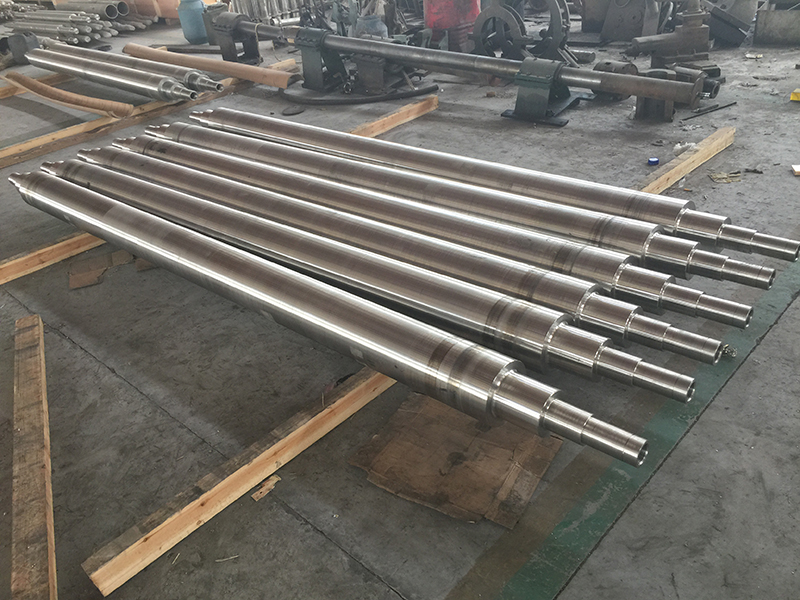
Glass Rolls
The production of French glass was an unprecedented undertaking in China. Due to the lack of any reference materials, it encountered one difficulty after another from the very beginning of the experimental production. Without designers, experts from the building materials department and a large number of scientific and technological personnel from Luobo were working on the design in the boiler room, drawing sketches and then starting the construction. Without large lathe equipment, the fitters of Luobo used the method of tinker patching POTS to process a 25-meter small tin bath on the spot. One significant challenge encountered in the production process at that time was that the high-temperature glass water was prone to solidify when passing through the tin bath, resulting in uneven thickness of the glass. Sometimes the glass water splashed randomly in the tin bath, and the workers were injured all over their bodies. After long-term consideration, the technicians of Luobo designed an electric heating device on the upper part of the tin bath, solving the problem that the glass water was prone to solidify when passing through the tin bath. Then, they independently developed a glass edge-pulling machine, carefully designing the speed, Angle and pressing depth, and modified the process shape of the forming part. The glass became wider and flatter as it was pulled, and the quality kept improving. On September 23, 1971, under the guidance of the Ministry's leaders and relevant experts, and with the full cooperation of sister units, the staff and workers of Luoyang Glass united and fought hard for more than three months. Finally, they successfully built the first float glass production line and produced the first float glass in China. The mechanical strength, flatness and light transmittance are all superior to those of other flat glasses. With his extraordinary wisdom and hard work, Luo Bo fulfilled the Chinese people's dream of floating. For float glass, due to its good uniformity in thickness, the transparency of its products is also relatively strong. Therefore, after the tin surface treatment, it is relatively smooth. Under the effect of smoothness, flame and polishing, a kind of glass with a relatively neat surface, good flatness and strong optical performance is formed. The decorative characteristics of this float glass are particularly good. It also features excellent transparency, brightness, purity, and bright indoor light, as well as a wide field of vision. At the same time, it is the best preferred material for building doors and Windows and natural lighting, and is one of the most widely used building materials. It can be said that among the various types of building glass, this float glass has the largest application. It is one of the most important raw sheets for deep processing of glass. Ultra-white float glass is mainly characterized by its best transparency and purity.

公司服务热线:
+86 15195227247